
 Contact
Selecting the right engineering plastic is rarely about finding the “best” material on a datasheet. In real applications, the best material is the one that can survive your actual load, heat, wear, and chemical exposure without pushing the project beyond budget.
Among engineering plastics, Nylon (Polyamide, PA) remains one of the most widely used platforms because of its strong balance of mechanical toughness, wear resistance, and compounding flexibility. However, nylon is not always the correct answer.
In many real-world designs, PP wins on cost, POM wins on dimensional precision, PPO/PPE blends lead in heat and electrical stability, and PBT remains a preferred choice for connectors and tolerance-sensitive housings.
What Makes Nylon (PA) Unique? The Reality of the Baseline
Before comparing nylon with other engineering plastics, it is important to understand why nylon is often treated as the baseline material in structural plastic design.
As a nylon compound manufacturer, we see nylon not simply as a resin, but as a highly adaptable engineering platform.
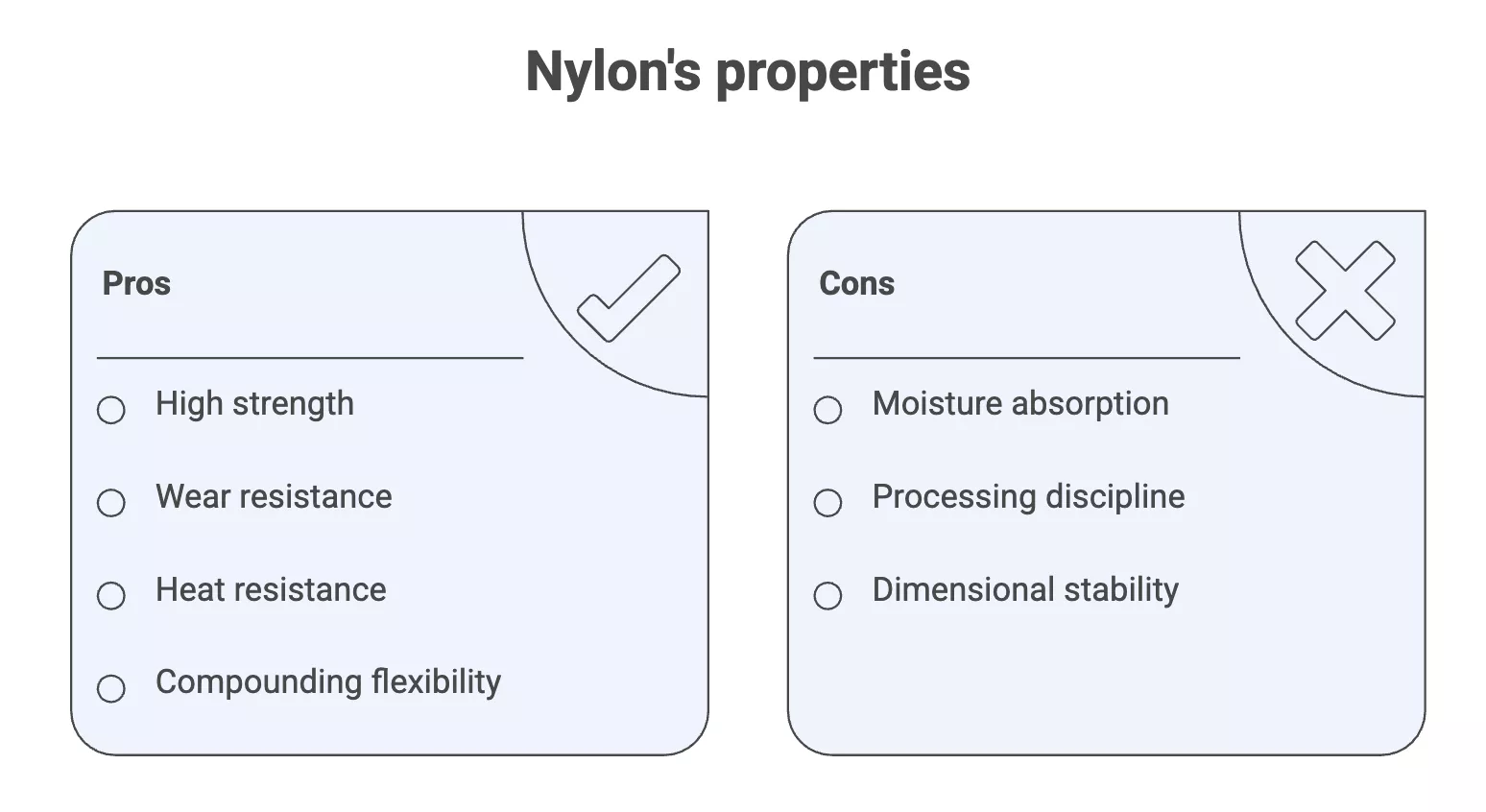
Nylon’s core strengths
- High mechanical strength and toughness, especially in reinforced grades such as GF, CF, and long-fiber systems
- Excellent wear resistance for gears, bushings, sliding parts, and functional housings
- Good heat resistance, particularly in PA66 and high-performance polyamide families
- Wide compounding flexibility using glass fiber, carbon fiber, impact modifiers, lubricants, flame retardants, and stabilizers
Nylon’s key limitations
- Moisture absorption, which may influence dimensions and mechanical behavior over time
- Higher processing discipline, especially for drying and stable molding control
- Not always the best option for ultra-stable dimensions in humid environments
For this reason, nylon is widely regarded as one of the most versatile engineering plastics — but not a universal solution for every application. If you want a broader introduction to nylon material families, you can also refer to our nylon material overview.
Nylon vs PP, POM, PPO & PBT: Quick Comparison Overview
This table is intended as a first-pass engineering filter. It does not replace validation testing, but it helps identify the most likely candidates before moving into detailed design evaluation.
| Material | Strength / Stiffness | Heat Resistance | Moisture Absorption | Dimensional Stability | Cost Level | Common Uses |
|---|---|---|---|---|---|---|
| Nylon (PA) | High | Medium–High | High | Medium | Medium | Gears, housings, wear parts |
| PP | Medium | Low | Very Low | High | Low | Packaging, covers, low-load parts |
| POM | High | Medium | Very Low | Very High | Medium | Precision gears, bushings |
| PPO / PPE blends | High | High | Low | High | High | Electrical housings, under-hood parts |
| PBT | Medium–High | Medium | Low | High | Medium | Connectors, sensor housings |
This comparison is useful when the goal is not simply to ask which material is “stronger,” but rather which one is most aligned with the part’s true failure risk.
Advanced Engineering Plastic Comparison Matrix: PA6, PA66, PA12, GF & CF
The following matrix provides a deeper comparison across major nylon grades and reinforced variants, while also placing them alongside other common engineering plastics.
| Material / Grade | Tensile Strength | Heat Resistance | Moisture Absorption | Dimensional Stability | Reinforcement Potential | Typical Application |
|---|---|---|---|---|---|---|
| PA6 | High | Medium | High | Medium | GF / CF | General mechanical parts |
| PA66 | Higher than PA6 | Higher | High | Medium | GF / CF | Automotive components |
| PA12 | Medium | Medium | Low | Higher than PA6/PA66 | Limited GF | Tubing, lightweight parts |
| PA6 GF30 | Very High | High | Medium–High | Improved | Glass Fiber | Structural housings |
| PA66 GF50 | Extremely High | High | Medium | Improved | High GF | Load-bearing brackets |
| PA CF | Very High stiffness | High | Medium | Improved | Carbon Fiber | Metal replacement |
| PP | Medium | Low | Very Low | High | Limited | Covers, packaging |
| POM | High | Medium | Very Low | Very High | Limited | Precision gears |
| PPO/PPE | High | Very High | Low | High | Limited | Electrical housings |
| PBT | Medium–High | Medium | Low | High | Limited | Connectors |
This matrix is especially useful when engineers are comparing not just nylon versus other plastics, but also which nylon family or reinforcement strategy makes the most sense for the application.
Nylon vs Polypropylene (PP): Strength, Cost, and Moisture Stability Compared
Key Selection Insight: PP is typically preferred for low cost, low moisture sensitivity, and lightweight components. Nylon is more often selected for load-bearing parts requiring better mechanical strength, wear resistance, and durability under stress.
Why designers pick PP
- Lower raw material cost and broad availability
- Very low moisture absorption and stable dimensions
- Good chemical resistance in many environments
- Easy processing for high-volume parts
Where nylon clearly outperforms
- Higher strength, better fatigue performance, and better wear resistance
- Better performance under dynamic loading
- More compounding options such as GF, CF, and impact modification
Practical rule of thumb
- If the part is mainly a container, cover, or low-load component, PP often wins
- If the part is a functional mechanical component such as a gear, bracket, or moving interface, nylon is usually the better starting point
For a more detailed breakdown, see our PA vs PP comparison guide.
Nylon vs POM (Acetal): Dimensional Stability, Friction, and Load Performance
Key Selection Insight: Choose POM when you need excellent dimensional stability, low friction, and precision fit. Choose nylon when you need higher strength potential and property tuning through compounding.
Why POM is hard to beat
- Very low moisture absorption
- Excellent creep resistance and dimensional stability
- Naturally low friction and good wear properties
- Strong choice for precision gears, bushings, bearings, and snap-fit parts
Where nylon wins
- Higher reinforcement ceiling with GF, CF, and long fiber
- Better impact and toughness in some modified grades
- Broader grade selection for different environments and mechanical targets
Practical rule of thumb
- If your biggest risk is tolerance drift, squeak, stick-slip, or precision fit, start with POM
- If your biggest risk is strength margin under load or the need for a custom compound, nylon is often the better platform
For more detail, read our PA vs POM side-by-side comparison.
Nylon vs PPO / PPE Blends: Heat Resistance and Electrical Performance Comparison
Key Selection Insight: Choose PPO/PPE blends for high heat resistance and electrical/thermal stability, especially in demanding housings. Choose nylon for mechanical strength, wear parts, and reinforced structural designs.
Why PPO/PPE blends are chosen
- Strong performance at elevated temperatures
- Good electrical insulation and stable dielectric behavior
- Suitable for electrical housings and under-hood applications
- Often selected where heat and dimensional stability are both critical
Where nylon wins
- Better wear and mechanical toughness in many mechanical systems
- Broader reinforcement and impact-modified possibilities
- Often more cost-flexible than high-end PPO/PPE systems, depending on grade
Practical rule of thumb
- For electrical housings near heat sources, PPO/PPE blends often lead
- For mechanical structures or wear-contact parts, reinforced nylon is usually the better base material
For more discussion, see our PA vs PPO full comparison.
Nylon vs PBT: Connector Applications, Moisture Resistance, and Dimensional Stability
Key Selection Insight: Choose PBT when you need stable dimensions, low moisture uptake, and reliable electrical housing performance. Choose nylon when you need higher toughness, better wear behavior, or reinforced mechanical strength.
Why PBT is popular in electrical and connector markets
- Low moisture absorption and stable tolerances
- Good electrical properties
- Often selected for connector housings and precision-fit components
Where nylon wins
- Better mechanical toughness in many applications
- Strong performance in wear-contact environments
- Reinforced nylon can exceed PBT in stiffness and load-bearing capability
Practical rule of thumb
- If your product is connector-heavy or highly tolerance-sensitive in humidity, PBT is often the safer option
- If the part is mechanically loaded or exposed to wear, nylon may provide stronger overall performance
For more detail, see our PBT vs Nylon comparison guide.
Nylon Grade Comparison: PA6 vs PA66 vs PA12 and Reinforced Variants
One of the main reasons nylon continues to dominate engineering applications is that it is not just one material. Choosing nylon often means deciding which polyamide family and which reinforcement strategy best matches the design target.
Common nylon comparisons
- PA6 vs PA66: strength, heat performance, and processing differences
- PA6 vs PA12 / PA66 vs PA12: moisture sensitivity, flexibility, and long-term stability
- Reinforced variants: when GF or CF is needed for structural performance and metal replacement
When your design is close to the limit in heat, creep, fatigue, or dimensional control, these grade-level decisions matter just as much as the broader question of nylon versus other plastics.
Related reading:
PA6 vs PA66 / PA6 vs PA12 / What is PA12
How to Choose Like a Pro
From a compounding perspective, the cheapest resin often becomes the most expensive part when lifecycle performance is ignored. A better material selection process begins by identifying the part’s real design risk.
1. When to Double Down on Nylon (PA)
Nylon is often the right platform when the part is a functional mechanical component requiring:
- Metal replacement: High-load brackets or structural housings needing a high stiffness-to-weight ratio
- Dynamic endurance: Gears, bushings, and sliding interfaces requiring fatigue and wear resistance
- Application tuning: When standard grades are not enough and a customized compound is needed
2. When to Pivot Away
It may be better to reconsider POM, PBT, PP, or PPO when the project hits one of these triggers:
- The 0.5% Rule: If even a small dimensional change caused by humidity can trigger failure, POM or PBT may be safer
- Silent operation: If the design requires low-noise plastic-on-plastic motion without lubrication, POM is often preferred
- Cost-driven non-structural parts: Decorative covers and low-load components often favor PP
- Heat + electrical stability: Electrical housings near heat sources often favor PPO/PPE or PBT
Nylon Cost and Processing Considerations in Engineering Applications
Procurement decisions should not be based on resin cost alone. In many projects, processing stability, scrap rate, and warranty risk can dominate total cost more than the raw material itself.
Key nylon cost drivers
- Drying requirements: poor drying may cause brittle parts, surface defects, and unstable properties
- Tool wear in reinforced grades: GF and CF systems may accelerate mold wear
- Cycle time and dimensional control: tighter tolerances often require stricter process control and conditioning standards
How to compare total cost
- Include scrap rate and warranty exposure in the cost model
- Evaluate whether reinforcement allows thinner walls or metal replacement
- Compare lifecycle performance under actual humidity and temperature conditions
This is also why lifecycle-oriented selection is increasingly important in plastic engineering, especially when materials are being evaluated for metal replacement applications.
Nylon vs Other Engineering Plastics: Technical FAQs
The following questions address common engineering concerns when comparing nylon with other performance plastics.
1. Is nylon stronger than polypropylene (PP)?
Yes. Nylon generally offers higher tensile strength, stiffness, and fatigue resistance than PP. However, PP provides lower cost, better moisture stability, and easier processing for non-load-bearing parts.
2. Does nylon absorb moisture, and does it matter?
Yes. Nylon absorbs moisture from the environment, which can change dimensions and mechanical behavior. In tolerance-critical applications, this must be considered during design and validation.
3. When should I choose POM instead of nylon?
Choose POM when you need excellent dimensional stability, low friction, and minimal moisture sensitivity. Nylon is preferred when reinforcement potential or broader compound customization is required.
4. Is reinforced nylon stronger than metal?
Reinforced nylon can replace metal in many applications where weight reduction, corrosion resistance, and cost efficiency are important. However, it should not be treated as a direct replacement for metal in every extreme-temperature or ultra-high-load condition without validation.
5. What is the difference between glass fiber and carbon fiber reinforced nylon?
Glass fiber increases stiffness at a more economical cost. Carbon fiber provides a higher stiffness-to-weight ratio and lower density, but typically at a higher material price.
6. Which engineering plastic is best for automotive parts?
It depends on the part function and service environment. As a general guideline:
- Gears and structural brackets → Reinforced Nylon
- Precision bushings → POM
- Electrical housings → PPO or PBT
7. Is nylon more expensive than PBT?
Pricing depends on grade and region. In many cases, nylon and PBT are in similar mid-range cost tiers, although reinforced nylon may add tooling wear and processing cost.
8. What is the most versatile engineering plastic?
Nylon is widely considered one of the most versatile engineering plastics because of its broad range of grades, reinforcement options, and balance between strength, wear resistance, and cost.
9. Can nylon be used in humid environments?
Yes, but moisture effects must be considered in dimensional design and tolerance calculations. For highly moisture-sensitive dimensions, POM or PBT may be more stable choices.
10. How do I select the right nylon grade?
The decision should consider load, temperature, environment, dimensional tolerance, and process conditions. For critical applications, compound-level evaluation is recommended.
A Structured Way to Choose the Right Engineering Plastic
Nylon remains one of the most versatile engineering plastics because it can be engineered into high-performance compounds — reinforced, toughened, and optimized for specific applications. At the same time, nylon is not always the best answer, especially when moisture-driven dimensional stability is the primary constraint.
A practical material selection workflow is to:
- Use the comparison table to shortlist the most likely candidates
- Match each material’s strengths to the part’s actual failure risks
- Validate using environmental and mechanical testing aligned with real service conditions
Material selection should not be left to guesswork. Whether the challenge is dimensional drift, long-term wear, or a structural metal-replacement target, the right engineering plastic is the one that performs reliably in the real world — not just on paper.
