
 Contact
When comparing PA12 vs TPU for structural impact applications, the real difference is not which material is stronger—but how each behaves under long-term load and repeated deformation.
PA12 is typically selected for dimensional stability and predictable structural performance, while TPU is preferred for elastic recovery and energy absorption.
Understanding this fundamental distinction helps engineers choose the right material based on real operating conditions rather than peak datasheet values.
This guide explains when PA12 or TPU is the right choice, and when alternative impact-modified nylons may offer a more practical solution.
Understanding the Real Question Behind PA12 vs TPU
PA12 and TPU frequently appear in similar applications—snap-fit features, housings, and protective components—leading to superficial comparisons.
However, they are engineered for different failure modes:
- TPU is optimized for elastic deformation and energy absorption
- PA12 is designed to maintain dimensional integrity with controlled toughness
Understanding this distinction is critical before comparing mechanical properties.
📌 Learn more about the mechanical properties of PA12 compounds.
At a Glance: Comparison Table
This quick comparison highlights the practical differences engineers care about in structural impact applications. Use it to align the material choice with the part's functional behavior over time—not just peak property values.
| Selection Factor | PA12 | TPU | Impact-Modified PA6/PA66 (Alternative) |
|---|---|---|---|
| Primary design intent | Structural stability with controlled toughness | Elastic deformation & energy absorption | Structural nylon with improved impact (often a practical balance) |
| Elastic recovery / rebound | Medium | High | Low to Medium (grade-dependent) |
| Long-term dimensional stability | High | Medium (risk of stress relaxation) | Medium to High (often more predictable than TPU) |
| Performance under long-term load | More predictable deformation behavior | May relax over time (fit/alignment drift risk) | Often suitable for load-bearing parts with impact demand |
| Chemical / oil / fuel exposure | Generally stable resistance | Formulation-dependent (validation recommended) | Good overall; confirm with the specific environment |
| Injection molding repeatability | Stable processing window; good dimensional control | Cooling & demolding variability can be higher | Often stable and production-friendly (widely adopted) |
| Post-molding handling deformation risk | Lower | Higher (more easily deformed during handling/assembly) | Lower to Medium |
| Best-fit part role | Housings, clips, brackets, structural parts needing stable geometry | Bumpers, pads, isolators, soft interfaces, flexible covers | Impact-resistant structural parts when PA12/TPU is unnecessary |
| Cost efficiency (typical) | Medium to High (depends on grade) | Medium to High (depends on grade) | Often more cost-effective vs PA12 when requirements allow |
📌 Quick rule of thumb: If the part must hold position / keep fit over time, start with PA12. If the part's job is cushioning / rebound, start with TPU. If you mainly need impact resistance in a structural nylon design, evaluate impact-modified PA6/PA66 first.
PA12 Material Applications: Industrial & Engineering Use Cases
PA12 is widely used in applications where dimensional stability and predictable long-term behavior are required.
Common real-world examples include:
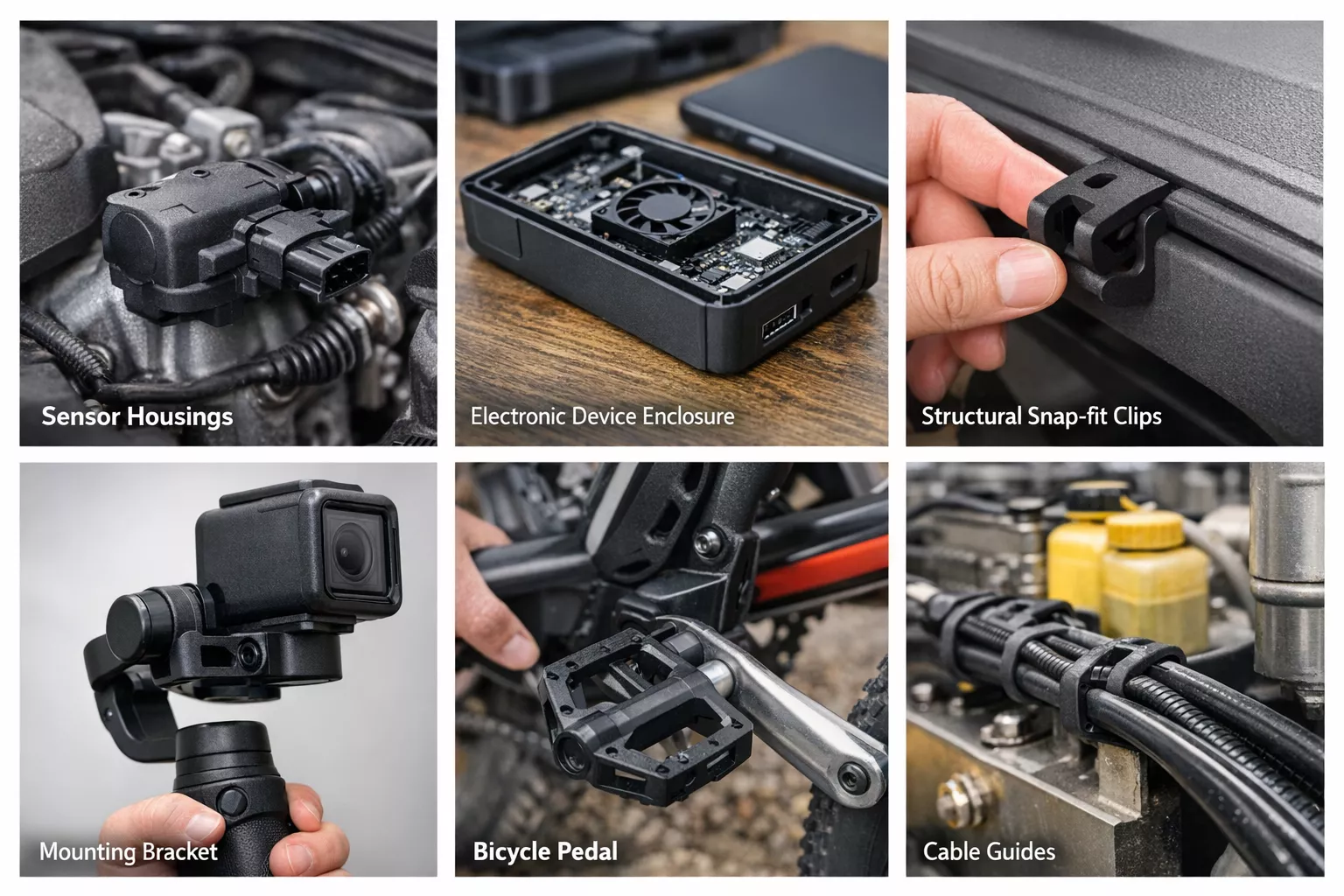
- Sensor housings for automotive and industrial equipment
- Electronic device enclosures requiring stable fit and alignment
- Structural snap-fit clips used in assemblies with repeated installation
- Mounting brackets for handheld or portable devices
- Sports equipment structural parts such as rigid pedals or supports
- Cable guides and routing components exposed to oils or fuels
PA12 is typically selected when parts must retain geometry and function over extended service life.
For real industrial application examples using glass fiber reinforced PA12, see PA12 GF30 industrial applications.
📌 In such applications, structural PA12 compound solutions are commonly used to balance impact resistance with long-term dimensional stability in injection-molded structural components.
📌 Long-term dimensional stability is closely related to warpage and shrinkage behavior—topics explored further in our overview of nylon warpage and shrinkage control.
TPU Material Applications: Industrial & Engineering Use Cases
TPU is commonly used in applications where elastic recovery and energy absorption are the primary functional requirements.
Typical examples include:
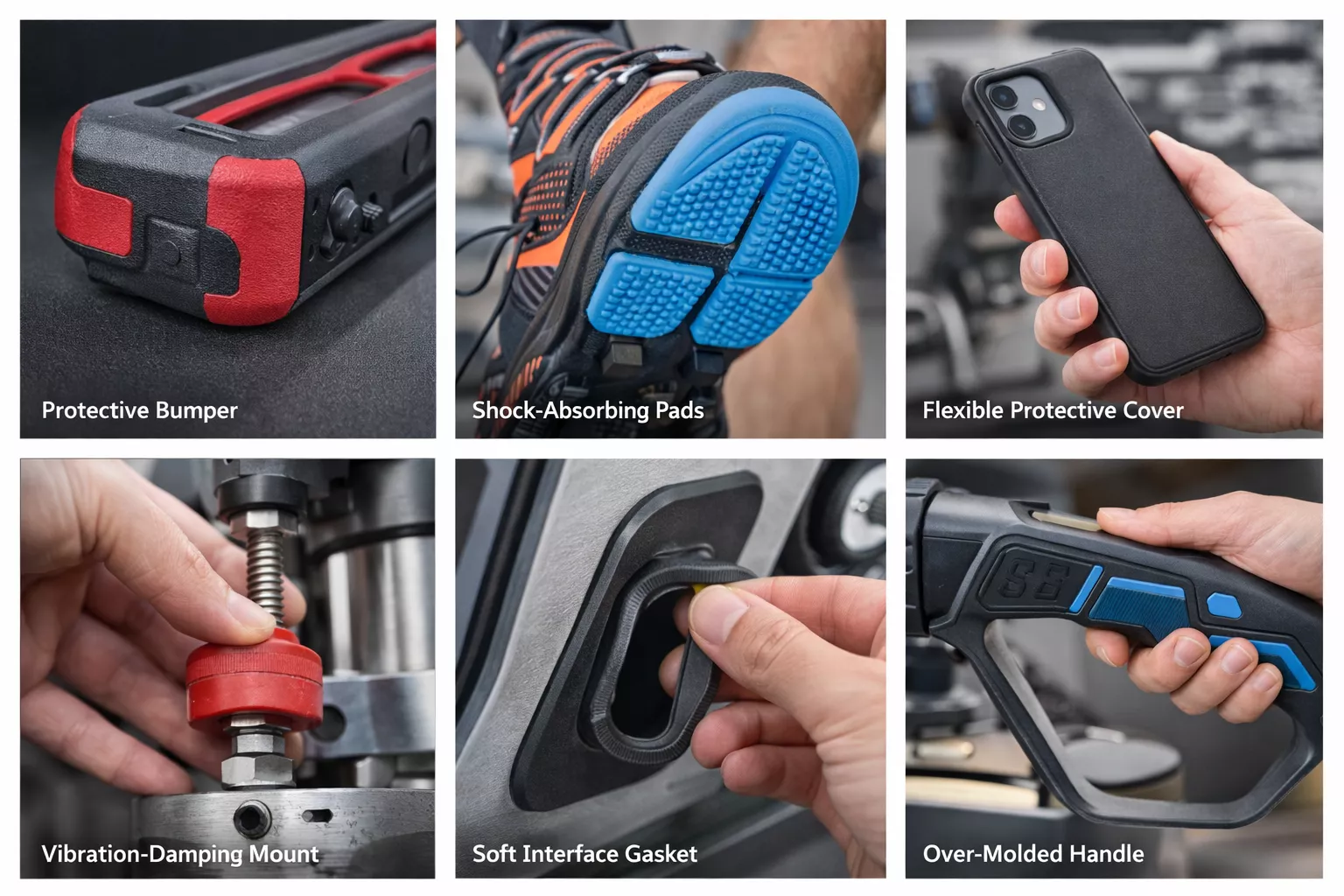
- Protective bumpers and edge guards for equipment housings
- Shock-absorbing pads in sports and consumer products
- Flexible protective covers and skins
- Vibration-damping mounts and isolators
- Seals, gaskets, and soft protective interfaces
- Over-molded grip sections and flexible straps
TPU excels in applications involving repeated deformation or impact damping rather than structural positioning.
Elastic Recovery vs Long-Term Dimensional Stability
TPU in Impact Applications
TPU offers excellent elasticity and immediate rebound, making it suitable for shock absorption, vibration damping, and flexible interfaces.
However, under constant or repeated mechanical load, TPU may experience stress relaxation. Over time, this can result in dimensional drift, affecting part fit, alignment, or function—especially in structural components.
PA12 as a Structural Material
PA12 provides lower elasticity but significantly better dimensional stability. Its deformation behavior under long-term load is more predictable, making it easier to manage in engineering design.
For components that must retain geometry, alignment, or load-bearing capability over their service life, PA12 is often the more reliable option.
Chemical and Environmental Resistance Considerations
PA12 typically offers stable resistance to oils, fuels, and common cleaning agents. Its chemical behavior is relatively consistent across applications.
TPU performance depends strongly on formulation. While some TPU grades perform well in chemical environments, others may swell or soften, requiring careful material selection and validation.
For structural applications, predictable material behavior is often more critical than peak performance values.
Injection Molding and Processing Behavior
From a processing perspective:
- TPU generally requires longer cooling times and presents higher variability during demolding. Dimensional repeatability can be more difficult to control.
- PA12 offers a wider processing window and more stable molding behavior, making it suitable for high-volume production of structural parts.
Post-molding, TPU components are more susceptible to deformation during handling or assembly, while PA12 allows better dimensional control during secondary processing.
Alternative Option: Impact-Modified PA6 or PA66
Do Impact-Resistant Designs Always Require PA12?
Not necessarily.
In many real-world applications, impact-modified PA6 or impact-modified PA66 can already provide sufficient impact resistance, particularly when extreme flexibility or chemical resistance is not required.
For a deeper comparison, see:
Compared with PA12, impact-modified PA6 or PA66 often offers:
- Adequate impact performance for real-world applications
- Broader availability and established processing experience
- A more cost-effective solution when material cost is a key consideration
📌 When evaluating alternatives to PA12 in impact-resistant designs, impact-modified PA6 and PA66 are often considered. This topic is discussed in more detail in impact-modified nylon for injection molding.
Practical Example from Application Experience
In one case, a customer developing a foot pedal component for sports equipment initially considered PA12 due to its impact resistance requirements.
After reviewing the actual loading conditions and impact demands, an impact-modified PA6 compound was recommended instead.
The result was:
- Lower overall material cost than originally anticipated: 400% reduced.
- Impact performance comparable to the original PA12 target
- Stable processing and reliable part performance in production
This example demonstrates that higher-grade materials are not always necessary when application requirements are clearly defined.
Key Takeaway
Material selection for impact-resistant components should be driven by functional behavior over time, not by peak impact values alone.
When long-term dimensional stability, processing reliability, and cost efficiency are key priorities, impact-modified PA6 or PA66 may provide a more practical solution than either PA12 or TPU in real-world structural applications.
Engineering FAQ: Quick Decision Guide
Do impact-resistant applications always require PA12?
No. Many applications can meet impact performance requirements using impact-modified PA6 or PA66.
Is TPU suitable for structural components?
TPU can be used in low-load structural applications, but stress relaxation and dimensional drift may occur under long-term load.
Is PA12 considered a flexible material?
PA12 is tougher and more flexible than conventional PA6 or PA66, but it is not an elastomer.
Which material offers better long-term dimensional stability?
For structural applications, PA12 and impact-modified PA6/PA66 generally provide more predictable dimensional stability than TPU.
Which material is easier to process for injection molding?
PA12 and impact-modified PA6/PA66 typically offer more stable processing windows and better dimensional repeatability than TPU.
Engineering-Driven Material Decisions
Choosing between PA12, TPU, or impact-modified PA6/PA66 is not about selecting the most advanced material—it is about selecting the most appropriate material for the application's real operating conditions.
Impact resistance, long-term dimensional stability, processing behavior, and cost must be evaluated together. When these factors are clearly defined, material selection often becomes simpler—and more cost-effective—than expected.
Early discussion of actual load conditions and service requirements allows engineering teams to avoid overdesign and identify material solutions that deliver reliable performance without unnecessary complexity.
