
 Contact
A molded nylon housing fits during initial inspection. After storage, its snap-fits become tight or its screw holes no longer line up. When did the dimensions begin to change? If the part is already out of tolerance after cooling, see our nylon injection molding guide for more on processing conditions and common molding problems. If the dimensions drift during storage or use, check whether moisture, heat, or load is contributing to the change.
Find out when the dimensions changed
Once the parts have cooled to the specified measurement temperature, record their weight and critical dimensions. Store parts from the same production lot at a defined temperature and relative humidity. At set intervals, weigh the parts and remeasure the same features, such as hole spacing, snap-fit clearance, mating surface flatness, or seal groove width.
- The part is already out of tolerance after cooling. Start by checking packing, cooling uniformity, and gate location. If the grade contains glass fiber, also consider fiber orientation.
- The part gains weight as its dimensions shift during storage. Moisture uptake may be contributing to the change. If the part also experiences heat or load in service, include those conditions in the evaluation.
- The change is concentrated in one direction or feature. Compare measurements along and across the flow direction. For glass-fiber-reinforced grades, check whether the pattern is consistent with fiber orientation.
If moisture uptake appears to be contributing and a critical feature goes out of tolerance under expected service conditions, use the current grade as the baseline for a material trial.
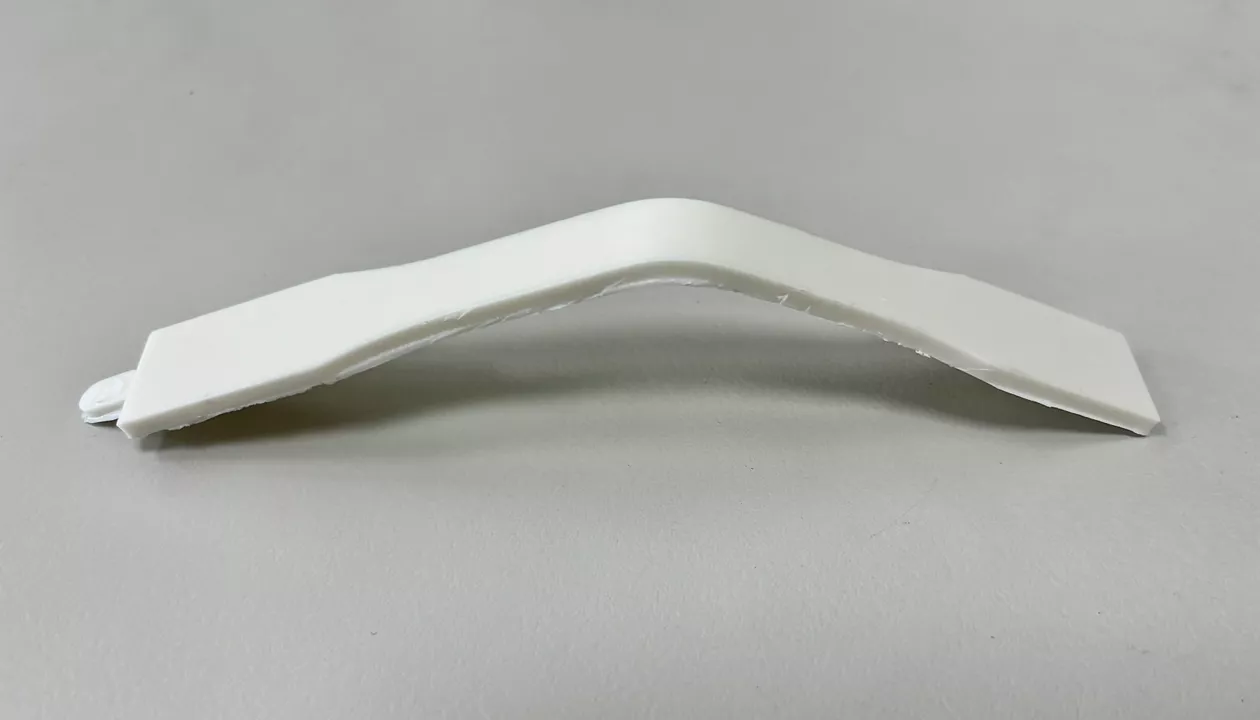
How to choose a nylon grade for humid conditions
Start with the dimension that went out of tolerance. Then compare candidate grades based on material cost, operating temperature, and the mechanical properties the part needs after conditioning.
| Material | When to consider it |
|---|---|
| PA6 | Material cost is a priority and the injection molding process is already established. If the current grade still meets assembly tolerances after conditioning, it may be worth retaining. |
| PA66 | The part needs to maintain stiffness or carry loads at elevated operating temperatures, as in equipment mounts or brackets. If the part also operates in a humid environment, check deformation under load at the expected temperature and humidity. |
| PA12 | The part is regularly exposed to humidity and needs to maintain tight assembly tolerances, as in outdoor equipment housings or precision assemblies. |
| Other low-moisture nylon compounds | The part needs to maintain its dimensions after moisture exposure while meeting specific stiffness, toughness, or surface finish requirements. If PA12 is the starting point, compare candidate grades for both material cost and dimensional performance. |
The choice of reinforcement depends on the part. If an unfilled grade meets the stiffness requirement, it can be a starting point for the trial. Consider glass fiber when the part needs more stiffness. If molded flatness is the main concern, compare mineral-filled grades or grades that combine glass fiber and mineral filler. For example, Ardlon® PA12 GF30 is a candidate for a housing that requires both low moisture uptake and additional stiffness. Explore Ardlon® PA12 GF30
For a broader comparison of PA6, PA66, and PA12, see our nylon material selection guide.
Read water absorption data alongside dimensional measurements
Water absorption measures how much mass a specimen gains. For an assembly, the acceptance criteria are often hole spacing, flatness, or clearance. When comparing datasheet values, check the exposure method, specimen conditions, temperature, and duration. A 24-hour immersion result and an equilibrium result at a specified relative humidity describe different exposure conditions. ISO 62 covers water absorption measurements for plastics. ISO 1110 covers accelerated conditioning of polyamide test specimens. ISO 62 · ISO 1110
For example, a drawing specifies a hole spacing of 100.00 ± 0.10 mm. The part measures 100.02 mm after cooling and 100.14 mm after storage. The stored part exceeds the 100.10 mm upper limit.
For the material trial, condition parts made from the current and candidate grades at the same temperature and humidity for the same duration. Measure the affected features against the same drawing tolerances and verify fit with the mating components. If the part also carries a load or must withstand impact, check those requirements after conditioning.
Ask All Around Polymer to help select a grade
Share your current material grade, critical dimensions and tolerances, operating temperature and humidity, and when the dimensional change first appears. All Around Polymer can help shortlist PA12 grades or develop a custom nylon compound based on your dimensional tolerances, stiffness, toughness, and surface finish requirements.
Send your part requirements · Explore Ardlon® PA12 compounds
