
 Contact
Recent geopolitical developments in the Middle East have contributed to upward pressure on crude oil prices, creating ripple effects across global energy and petrochemical markets. While much of the discussion typically focuses on commodity plastics such as PE and PP, the impact on polyamide (PA)—including PA6 and PA66—is equally significant, though structurally more complex.
Unlike commodity polymers that are closely tied to olefin pricing, PA sits further downstream in the petrochemical value chain. Its production relies on multiple intermediate chemicals derived from oil-based aromatics, making its cost structure more layered and sensitive to upstream disruptions.
If you are new to this material family, you can also start with our polyamide material overview to better understand how different nylon types are used across engineering applications.
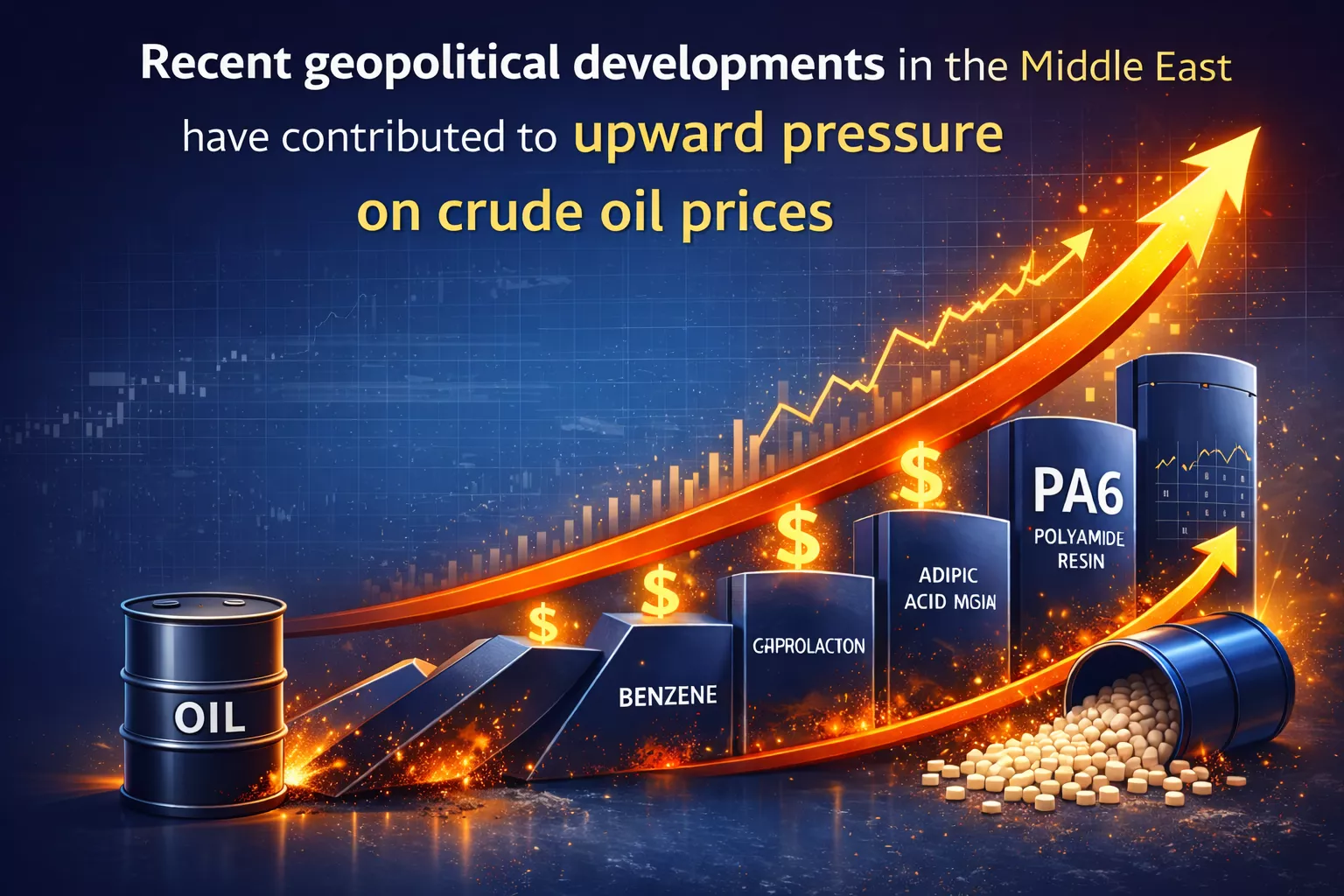
The Oil–Petrochemical–PA Chain: A Layered Dependency
The production pathways for PA illustrate this complexity clearly:
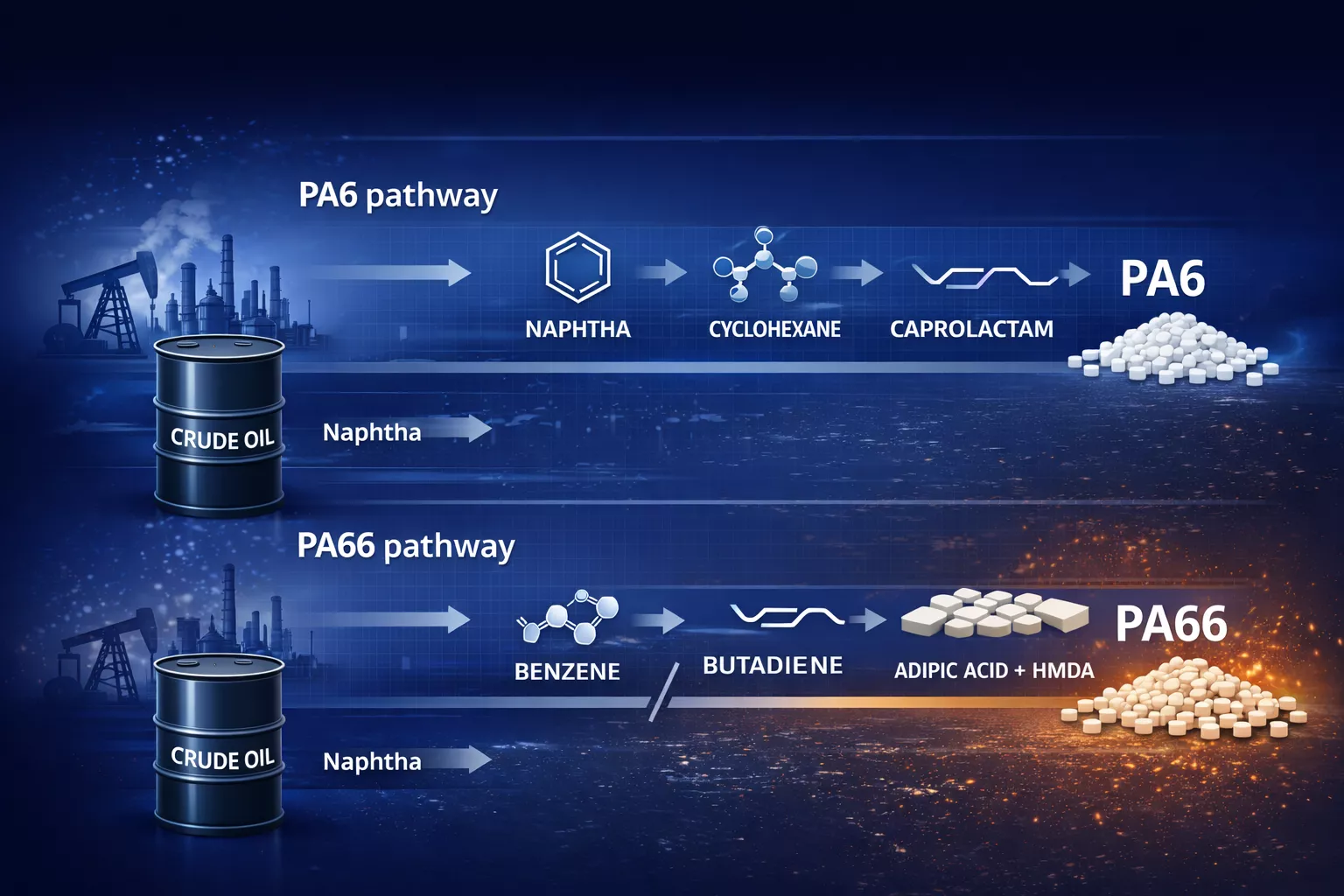
PA6 pathway
Crude Oil → Naphtha → Benzene → Cyclohexane → Caprolactam → PA6
PA66 pathway
Crude Oil → Naphtha → Benzene / Butadiene → Adipic Acid + HMDA → PA66
This multi-step conversion means that PA pricing is influenced not only by crude oil, but also by fluctuations in benzene and key intermediates such as caprolactam, adipic acid, and HMDA. Each step introduces additional cost sensitivity and potential supply constraints. As a result, PA does not simply track oil price movements—it often magnifies them due to cumulative cost pass-through effects.
Why PA Prices React Strongly to Oil Spikes
When geopolitical events drive oil prices upward, several mechanisms simultaneously impact PA:
1. Benzene prices increase
As aromatics markets tighten alongside crude, benzene prices tend to move upward. Since benzene is a core feedstock for both PA6 and PA66, even moderate increases can significantly raise caprolactam and adipic acid production costs.
2. Intermediate supply becomes constrained
Caprolactam and adipic acid production are capital-intensive and geographically concentrated, with limited flexibility to rapidly expand output. This creates not only cost inflation but also supply tightness, especially when operating rates are reduced or logistics are disrupted.
3. Cost escalation compounds through the chain
By the time these increases propagate through the value chain to finished PA resin, multiple layers of cost escalation have accumulated.
PA6 vs PA66: Different Sensitivity to Market Shocks
In the current market, PA66 has shown greater sensitivity to disruptions than PA6. This is largely due to its more complex supply chain, which depends on both adipic acid and HMDA—materials with relatively limited global capacity and higher supply concentration.
For readers comparing both materials from a technical and supply perspective, our PA6 vs PA66 difference and comparison guide provides a more detailed breakdown.
Why PA66 is more exposed
- Its value chain depends on more critical intermediates
- Global supply concentration is higher
- Lead times and supply visibility can deteriorate faster during volatility
How PA6 compares
- PA6 benefits from a comparatively simpler supply chain
- Price increases still occur, but the magnitude is often less severe
- Many manufacturers evaluate PA6 as a cost-effective alternative when performance requirements allow
PA66 and PA6 Comparison Under Market Volatility
| Comparison Area | PA66 | PA6 |
|---|---|---|
| Supply Chain Complexity | Its value chain depends on more critical intermediates. | PA6 benefits from a comparatively simpler supply chain. |
| Global Supply Concentration | Global supply concentration is higher. | Supply is generally less concentrated, helping reduce exposure to disruption. |
| Market Volatility Impact | Lead times and supply visibility can deteriorate faster during volatility. | Price increases still occur, but the magnitude is often less severe. |
| Commercial Evaluation | More exposed to market shocks and supply-side uncertainty. | Many manufacturers evaluate PA6 as a cost-effective alternative when performance requirements allow. |
Current PA Market Situation (2026)
The PA market is currently experiencing a cost-driven upward cycle. PA6 prices have been trending upward alongside caprolactam costs, while PA66 has experienced more pronounced price pressure, reflecting constraints in adipic acid and HMDA supply.
Current market behavior
- Suppliers are issuing frequent price increase announcements
- Quotation validity periods are shortening
- Buyers are adopting a more cautious, wait-and-see approach
Regional observations
- Asia: relatively stable, but cautious
- Europe: facing higher energy cost pressure
- Middle East: continues to influence upstream chemical availability
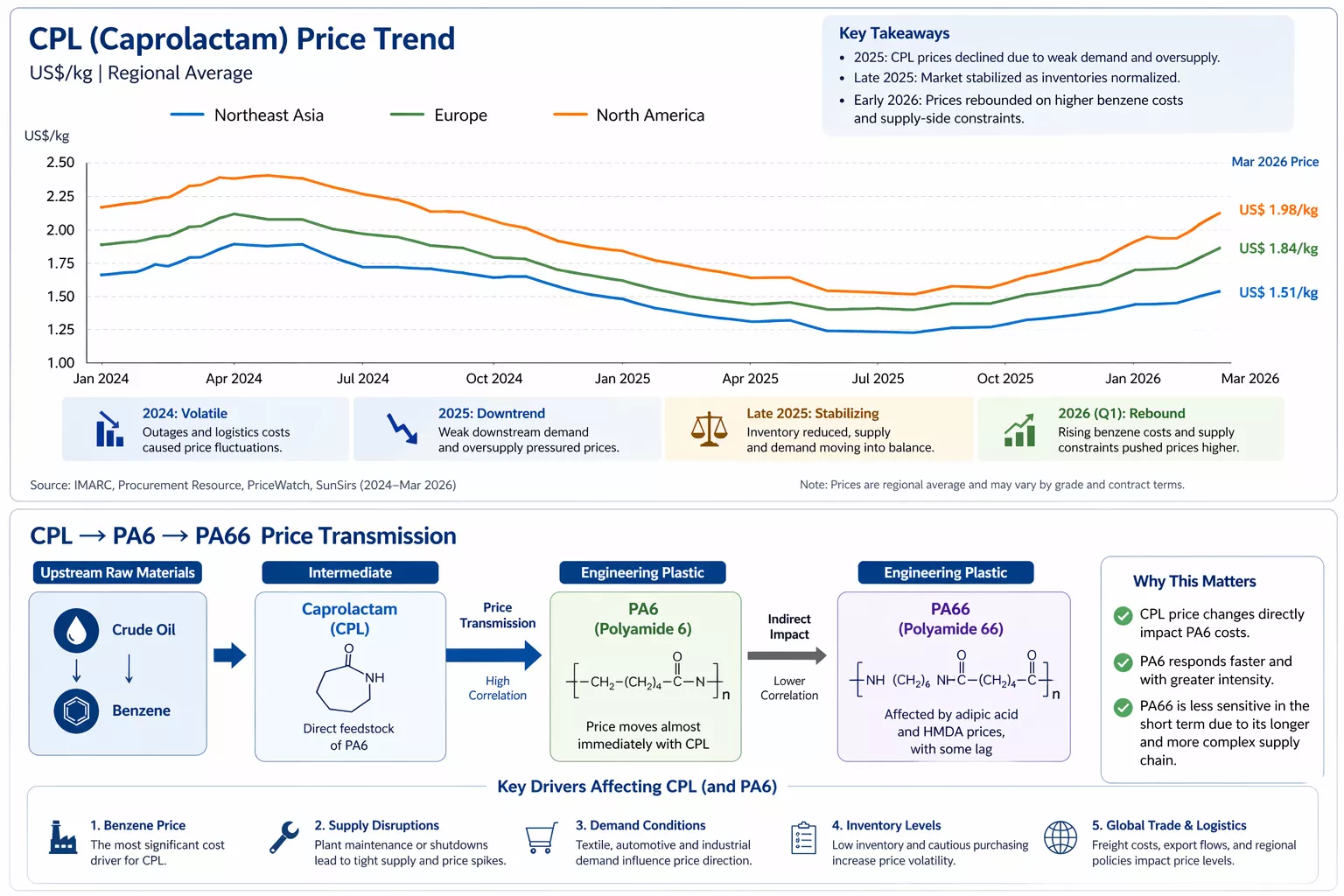
Beyond Raw Materials: Why PA Is More Exposed
Beyond feedstock costs, PA is inherently more sensitive due to its production and application characteristics.
Structural reasons PA is more vulnerable
- High-energy polymerization: PA production requires significant energy input and controlled processing conditions
- Engineering application dependency: PA is widely used in automotive, electrical, and industrial applications where demand is less elastic
- Compound complexity: PA compounds often include glass fiber, impact modifiers, and mineral fillers, which add another layer of cost exposure
Because of these factors, PA pricing is affected not only by resin costs, but also by broader system-level cost pressures that extend across energy, additives, and technical formulation requirements.
What This Means for PA Compound Buyers
While the discussion above focuses on PA resin pricing, buyers of PA compounds—such as glass-fiber reinforced grades, impact-modified formulations, or mineral-filled systems—face an additional layer of cost complexity.
Since compound pricing also depends on reinforcement and modifier selection, it is helpful to understand the broader range of types of nylon composite materials used in real applications.
PA compounds are not simply resin plus additives. The compounding process integrates multiple raw materials, each with its own cost trajectory. When PA resin prices rise due to upstream feedstock pressure, the impact on compound pricing is further amplified by simultaneous increases in glass fiber, impact modifiers, and other functional additives.
For end-use applications across automotive components, electrical and electronic systems, industrial machinery, and consumer products, this means that material budgets can shift significantly within a short period—even when resin price movements appear moderate on the surface.
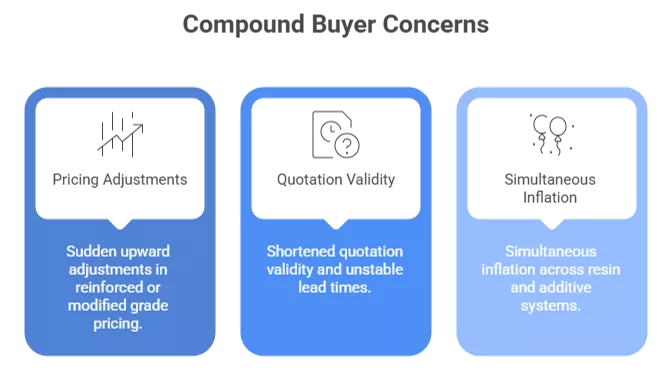
What compound buyers should watch closely
- Sudden upward adjustments in reinforced or modified grade pricing
- Shortened quotation validity and unstable lead times
- Simultaneous inflation across resin and additive systems
Why an experienced compounding partner matters
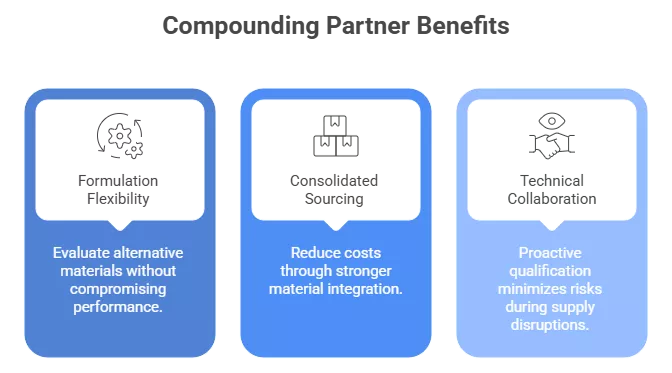
- Formulation flexibility: alternative base resins or additive systems may be evaluated without sacrificing application performance
- Consolidated sourcing: stronger material integration can reduce cumulative cost pressure
- Technical collaboration: proactive qualification reduces the risk of last-minute substitutions during supply disruption
In volatile markets, formulation flexibility becomes increasingly important, especially when evaluating PA compounds, additives, and customization strategies for cost and performance balance.
In volatile markets, the value of a compounding partner lies not only in the material they supply—but in the stability, expertise, and responsiveness they bring to your supply chain.
Key Takeaway
The relationship between oil and plastic pricing is structural—but for PA, it is multi-layered and amplified. Positioned at the intersection of petrochemical feedstock volatility, complex intermediate supply chains, and high-performance engineering demand, polyamide is particularly sensitive to geopolitical disruptions.
As a result, PA pricing is not only reactive but often more volatile and less predictable than that of commodity plastics.
If you are reviewing material strategies under cost pressure, our engineering plastics guide can also help you compare nylon with other materials more systematically.
How All Around Polymer Supports You Through Market Volatility
In an environment of rising raw material costs and uncertain lead times, your choice of compounding partner matters more than ever.
At All Around Polymer, we go beyond simply supplying PA compounds. With decades of experience in PA6 and PA66 formulation, we monitor upstream feedstock trends closely—allowing us to provide timely market guidance, stable sourcing strategies, and technically optimized solutions tailored to your application needs.
- Evaluate PA6 alternatives when cost pressure rises
- Support supply continuity planning for volatile markets
- Develop compounds that balance performance with material efficiency
Whether you are looking to manage cost exposure, secure supply continuity, or optimize compound design for real-world applications, our team is ready to work with you.
Facing pressure from rising PA material costs? Contact us today to discuss your sourcing needs and explore how All Around Polymer can help you navigate today's market.
