
 Contact
When selecting engineering plastics, one of the most common questions engineers ask is:
"Is nylon actually stronger than PP, ABS, POM, PC, PBT—or even metal?"
Although this seems straightforward, "strength" depends on multiple factors, including tensile strength, stiffness, heat resistance, moisture absorption, fatigue performance, and how the material behaves under load. No material is universally stronger; each performs differently depending on the application.
Across many projects, we often help customers evaluate whether their current material is reaching its performance limit—especially when upgrading from PP/ABS to a structural material, replacing metal to reduce weight, or improving stability in heat-exposed environments.
This article provides a clear, engineering-oriented comparison to help determine whether nylon (PA6/PA66) is truly stronger in your specific case.
Why Engineers Compare Nylon with Other Plastics
During material selection, several questions frequently appear:
- Is PP or ABS stiff enough for a load-bearing part?
- Will POM provide better wear resistance than PA?
- Is PC a better choice when impact strength matters?
- Can nylon achieve the same strength as metal while reducing weight?
- How much does moisture absorption affect nylon's properties?
In real industrial cases, the question is rarely
- "Which material is strongest?"
but rather:
- "Which material maintains the required performance under actual operating conditions?"
That's where nylon often becomes a preferred upgrade.
Is Nylon Stronger Than PP?
Strength & Stiffness
| Property | PP | PA6/PA66 |
|---|---|---|
| Tensile Strength | 25–35 MPa | 65–90 MPa |
| Flexural Modulus | 1.2–1.5 GPa | 2.5–3.5 GPa |
👉 Nylon is roughly 2–3× stronger and significantly stiffer than PP.
When Nylon Wins
- Structural or load-bearing parts
- Applications requiring higher stiffness
- Components exposed to heat
- Parts where durability is important over time
When PP Wins
- High-volume, cost-sensitive applications
- Chemical/solvent exposure
- Thin-wall containers
- Applications requiring transparency
Is Nylon Stronger Than ABS?
Strength Comparison
| Property | ABS | PA6/PA66 |
|---|---|---|
| Tensile Strength | 40–50 MPa | 65–90 MPa |
👉 Nylon provides clearly higher strength than ABS.
Impact Performance
ABS offers excellent impact resistance.
Impact-modified PA grades can exceed ABS in real-use scenarios, especially in colder environments or where part geometry limits wall thickness.
Dimensional Stability
ABS absorbs almost no moisture.
Nylon does—so dimensional change must be considered.
When Nylon Wins
- Structural components requiring higher mechanical strength
- Higher temperature environments
- Applications where long-term durability matters
When ABS Wins
- Indoor housings and aesthetic parts
- Applications requiring stable dimensions
- Cost-sensitive consumer goods
Is Nylon Stronger Than POM (Acetal)?
Strength
| Property | POM | PA6/PA66 |
|---|---|---|
| Tensile Strength | 60–70 MPa | 65–90 MPa |
→ Strength is close, though PA66 is typically higher.
Wear & Friction
POM excels in friction and wear, making it a common choice for:
- Gears
- Bearings
- Sliding mechanisms
Heat Resistance
PA66 has higher continuous-use temperature capability than POM.
Practical Engineering Experience
In real engineering projects, we often see POM performing very well when low friction is the primary requirement. However, when the counterpart material is harder, or when the part operates under higher loads, elevated temperature, or long duty cycles, POM can gradually reach its performance limits.
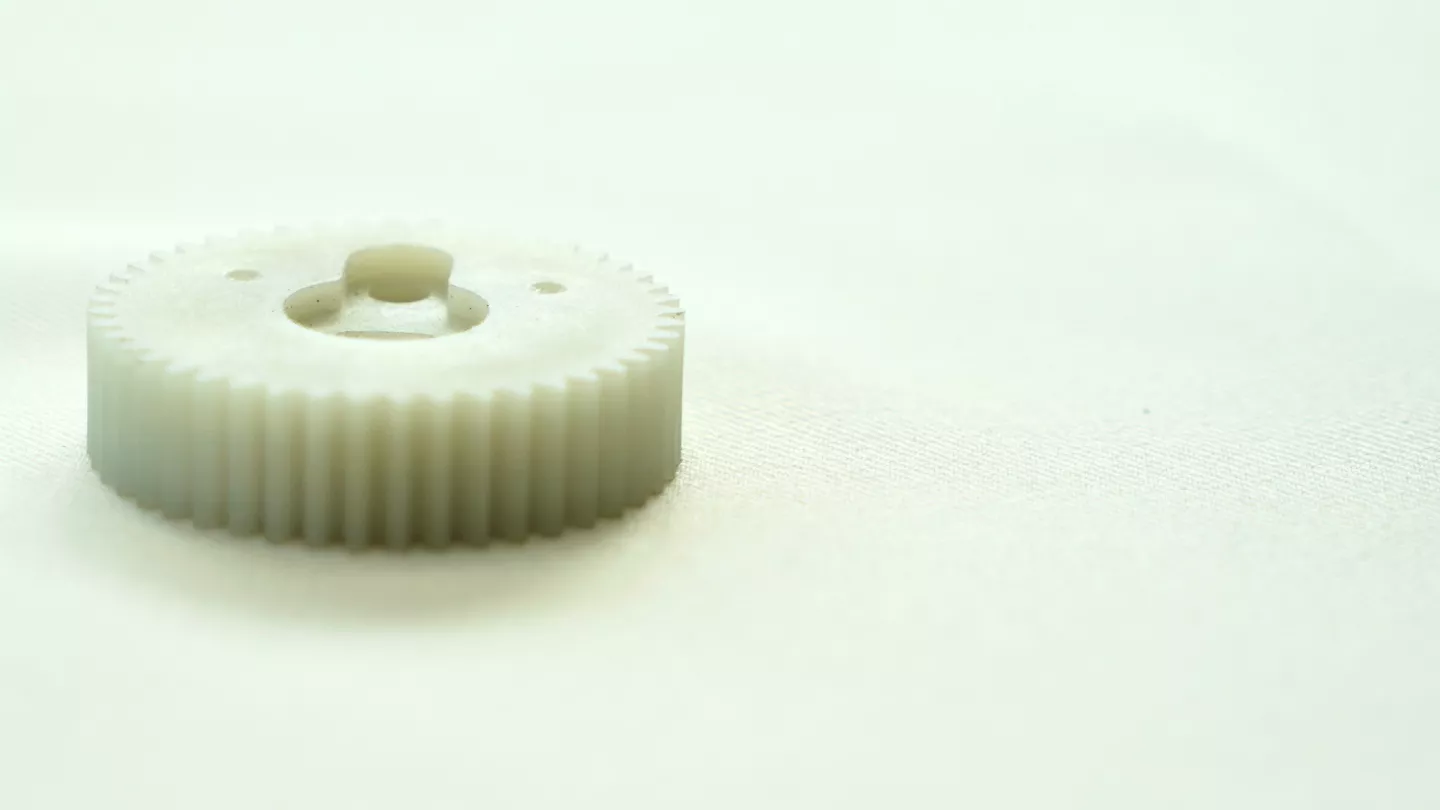
In several customer cases involving gears, cam followers, and sliding blocks, POM operated smoothly at the beginning but later exhibited wear, creep, or dimensional drift once thermal or mechanical stress accumulated. Under these conditions, glass fiber reinforced PA6 or PA66 provided more consistent long-term performance, offering higher stiffness and improved heat resistance while still maintaining acceptable sliding performance with appropriate design considerations.
When Nylon Wins
- Sliding components with added structural load
- Applications requiring better high-temperature rigidity
- Mechanisms sensitive to creep and deformation
When POM Wins
- Precision gears and bearing surfaces
- Low-friction components
- Applications where minimal moisture absorption is crucial
Is Nylon Stronger Than PC?
Strength
| Property | PC | PA6/PA66 |
|---|---|---|
| Tensile Strength | 60–70 MPa | 65–90 MPa |
→ Nylon is slightly stronger, though values are close.
Impact Strength
PC remains the benchmark for high-impact performance.
Appearance
PC can be transparent; nylon cannot.
When Nylon Wins
- Wear resistance
- Higher working temperature
- Structural components requiring high stiffness
When PC Wins
- Transparent components
- Ultra-high impact resistance applications
- Indoor housings or covers
Is Nylon Stronger Than PBT?
Strength
| Property | PBT | PA6/PA66 |
|---|---|---|
| Tensile Strength | 50–65 MPa | 65–90 MPa |
→ Nylon is stronger.
Dimensional Stability
PBT absorbs minimal moisture → excellent dimensional control
Nylon absorbs moisture → flexibility increases and dimensions shift
When Nylon Wins
- Structural and load-bearing parts
- High stiffness and strength requirements
- Glass fiber reinforced applications
- When density-to-strength ratio is considered
When PBT Wins
- Electrical and electronic connectors
- Automotive electrical housings
- Applications requiring tight tolerances and dimensional stability
Is Nylon Stronger Than Metal?
This comparison is often misunderstood.
Strength-to-Weight Ratio Is the Key
| Material | Tensile Strength |
|---|---|
| Aluminum Alloy | 150–300 MPa |
| PA66 GF30 | 140–200 MPa |
| PA66 GF50 | 220–260 MPa |
👉 GF-nylon can match or exceed aluminum in strength-to-weight ratio.
When Nylon Wins
- Weight reduction (30–50%)
- Complex geometries where metal machining is costly
- Applications operating below 120–150°C
- Noise and vibration reduction
When Metal Wins
- Long-term fatigue loading
- Continuous high-temperature use
- Extreme impact or shock loads
Summary Table
| Material | Is Nylon Stronger? | When Nylon Wins | When Other Material Wins |
|---|---|---|---|
| PP | ✔ Yes | Structural parts | Cost-driven uses |
| ABS | ✔ Yes | Higher stiffness | Indoor housings, aesthetics |
| POM | ✔ Slightly | High temp, stiffness, fatigue | Sliding parts, gears |
| PC | ⚪ Similar | Wear, stiffness | Ultra-high impact |
| PBT | ✔ Yes | Strength & structure | Dimensional stability |
| Metal | ⚪ Depends | Weight reduction | High temp, fatigue loads |
So, is nylon stronger than PP, ABS, POM, PC, PBT, and metal?
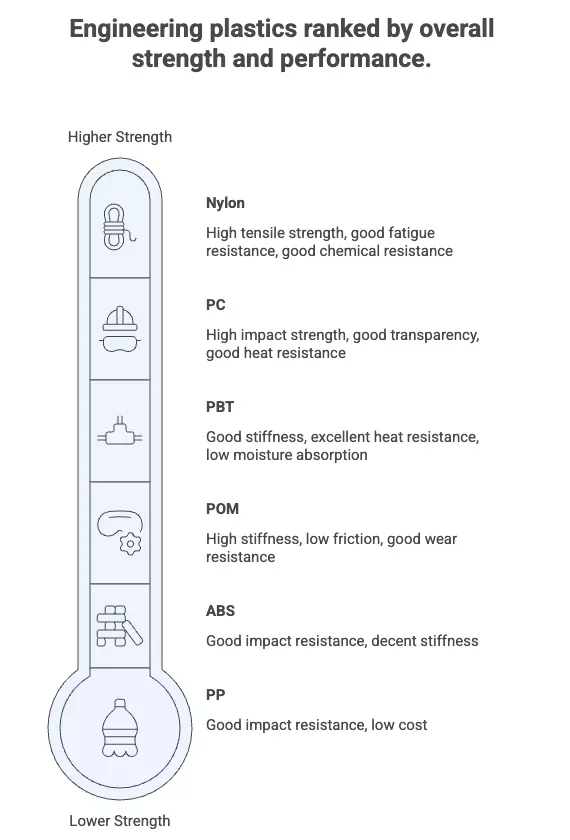
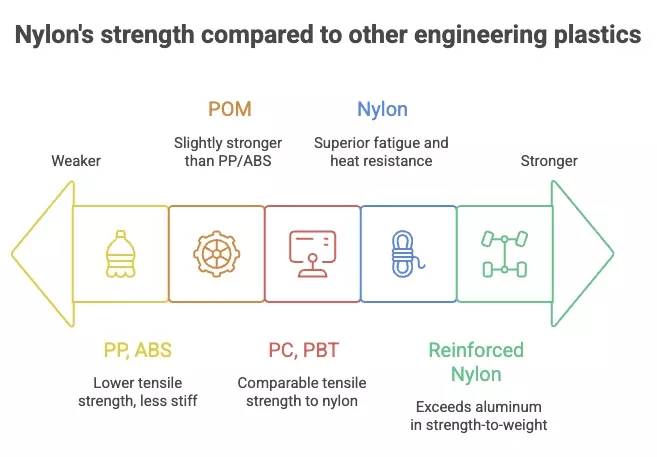
In most engineering applications, nylon (PA6/PA66) is significantly stronger and stiffer than PP and ABS, slightly stronger than POM, and generally comparable to PC and PBT in tensile strength—while offering superior fatigue and heat resistance in structural designs.
When reinforced with glass or carbon fiber, nylon can approach or even exceed aluminum alloys in strength-to-weight performance, making it a practical option for metal replacement in many load-bearing components.
However, nylon's moisture absorption, processing conditions, and operating environment play a critical role in determining real-world performance. As a result, nylon is not universally "stronger", but it is often the most balanced material when strength, stiffness, weight reduction, and long-term durability must be considered together.
FAQ: Is Nylon Stronger Than Other Engineering Plastics?
This FAQ section addresses the most common material selection questions engineers ask when comparing nylon with PP, ABS, POM, PC, and PBT. The answers focus on real-world performance, structural strength, and practical design considerations rather than datasheet values alone.
Q1: Is nylon stronger than PP and ABS?
Yes. Nylon (PA6/PA66) has significantly higher tensile strength and stiffness than PP and ABS, making it more suitable for structural and load-bearing components. PP and ABS are often chosen for cost, impact resistance, or aesthetics rather than mechanical strength.
Q2: Is nylon stronger than POM for gears and moving parts?
Nylon and POM have similar tensile strength, but they excel in different applications. POM performs best in low-friction, precision components, while nylon—especially reinforced grades—offers better stiffness and durability under higher loads and elevated temperatures.
Q3: Can nylon replace metal in strength-critical applications?
In many cases, yes. Glass fiber reinforced nylon can approach or exceed aluminum alloys in strength-to-weight ratio, making it suitable for metal replacement where weight reduction, complex geometry, and vibration damping are important. Metals are still preferred for extreme temperatures and long-term fatigue loading.
Q4: Does moisture absorption reduce nylon's strength?
Moisture absorption reduces nylon's stiffness but increases its toughness. While dimensional changes must be managed, properly designed nylon components can maintain reliable strength and performance in real operating environments.
Key Insights for Material Selection
From an engineering perspective:
- Among common engineering plastics, nylon is generally stronger and stiffer.
- GF- or CF-reinforced nylon can enter the performance range of metals.
- Moisture absorption remains nylon's primary limitation.
- Processing conditions directly influence nylon's final strength.
In real projects, we often see large performance differences in the same nylon grade due to:
- Fiber orientation
- Mold temperature
- Moisture content before molding
- Cooling rate
In many cases, the process window affects the final strength more than the material grade itself—an important point often overlooked during material selection.
Looking for the right nylon compound for your structural application?
If you are upgrading from PP/ABS, evaluating reinforced PA6/PA66, or exploring metal replacement designs, All Around Compounding can support your material selection with engineering-oriented recommendations and trial samples.
